Microbial destabilization of methane hydrates
The SwarmMicrobial destabilization of methane hydrates is the novel biological mechanism that turns deep-sea microbes and their worm hosts into agents of geological change. In the account developed by Gerhard Bohrmann and Yvonne Mirbach, worms carry methane-consuming archaea into frozen hydrate deposits; the microbes then weaken those deposits from within. The consequence is not merely local decay: gas release can fracture the seabed and help set off a large-scale slope collapse. The mechanism makes an invisible microbial process part of the same causal chain as a submarine landslide and tsunami.
The microbial partnership
Methane hydrates are dense, ice-like deposits that hold methane within water crystals. The relevant microbes are not acting alone. Bohrmann explains that sulphur bacteria and archaea form consortia, symbiotic partnerships found on hydrates only a few years before the crisis. The sulphur bacteria use oxygen to break down nutrients, including compounds released by the archaea; the archaea can break down methane without oxygen and continue doing so far beneath the seabed.
That division of conditions helps explain why the partnership can operate within sediments where oxygen is scarce. Archaea were estimated to convert 300 million tonnes of marine methane each year. Under ordinary circumstances, this activity could benefit the climate by consuming methane before it escaped into the atmosphere as a greenhouse gas. The same process becomes dangerous when the microbes are carried beyond their usual position in the seabed and into the hydrate layer itself. Their environmental role is therefore conditional: the process that limits methane release in one setting can contribute to it in another.
Worms as transporters
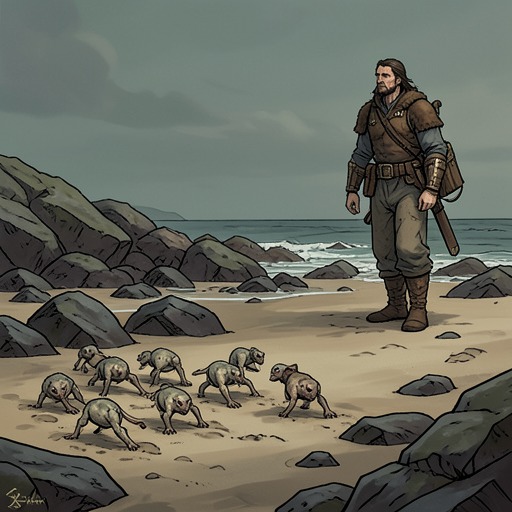
The worms’ significance lies less in their ability to break apart the hydrate directly than in their capacity to transport the microbial consortium. The mutant worms are covered with archaea and sulphur bacteria, which live in their guts and on their skin. As a worm burrows down through the ice, it carries the consortium with it, delivering archaea into material they could not otherwise reach as readily. Bohrmann likens the worms’ role to shuttle buses carrying their microbial cargo to successive depths in the hydrate.
Once introduced, the archaea break down the hydrate from the inside. The worm eventually dies, as do the sulphur bacteria, but the archaea continue through the ice. In this account, the deposit changes from a dense frozen layer into a porous, friable mass, allowing gas to leak toward the surface. The chain depends on distinct contributions: the worm transports, the bacterial partner participates in the consortium, and the archaea consume methane. Treating the worm as the direct destabilizing agent would miss the mechanism that makes the invasion consequential.
A mechanism overlooked in the forecasts
Before this explanation emerged, hydrate experts had a familiar list of destabilizing conditions: fluctuating water temperatures, falling hydrostatic pressure, and earthquakes. Microbial activity was known, but it had not been treated as a threat capable of transforming hydrate deposits at such a scale. Bohrmann’s reaction captures the conceptual obstacle: it seemed implausible that organisms too small to see could undermine a layer of ice a hundred metres thick or affect thousands of square metres of seabed. The danger was not that microbes were unknown, but that their geological consequences had not been imagined.
The scale and distribution of the worms sharpened that realization. They were present along the length of the Norwegian continental slope, in numbers that made the event difficult to account for through familiar models. Bohrmann also wondered how they had reached the slope and what had brought them there. The narrative raises that question without answering it in this explanation: it establishes the transport-and-breakdown mechanism, but not the origin of the infestation.
Mirbach identifies a second weakness in the forecasts: the first simulation relied on largely linear assumptions, whereas the unfolding process was chaotic and potentially exponential. As hydrate ice crumbles, gas escapes from within it; the escaping gas cracks additional hydrate, and the seabed begins to collapse. Each stage can intensify the next. Mirbach warns that the projected crisis point might be weeks away, days away, or closer still, while stressing that the unusual scenario could not be proved with certainty. The danger is thus presented as both mechanistically coherent and difficult to predict precisely.
From destabilization to slope collapse
The process is placed against the history of the Norwegian shelf. Earlier landslides had removed more than 5,500 cubic kilometres of material, leaving a sediment trail over 800 kilometres long in the sea between Scotland, Iceland, and Norway. The largest of these events had occurred within the past 10,000 years. Scientists had named it the Storegga Slide and hoped such a collapse would not recur. The text suggests that natural changes in temperature, including ice ages and warm periods, might otherwise have produced slides at intervals of several thousand years. The worm invasion, acting together with the surrounding conditions, brings the danger forward.
When the hydrates disintegrate, the physical consequences unfold across 150 kilometres of slope. Water and methane crystals break open explosively, releasing gas that rises through the seabed, fractures rocks, and contributes to the shelf lifting and sliding forward. Cubic kilometres of stone cave in. Further layers collapse, debris falls onto more stable deposits, and the moving material is reduced to mud. The shelf between Scotland and Norway, with its oil wells, pipelines, and platforms, begins to show signs of cracking. Microbial destabilization is therefore not an alternative name for the landslide; it is the initiating biological pressure in a wider chain of hydrate failure, gas release, and slope movement.
Microbial action and the limits of analogy
Elsewhere, Sue Oliviera describes chemical communication among microbes. In Myxococcus xanthus, a starving cell emits a signal; as more cells become starved, the signal intensifies until the swarm gathers into a fruiting body. Her later account of Yrr communication likewise describes a pheromone that can prompt free-floating cells to aggregate, alongside paired receptors that distinguish membership from cellular health. These discussions show how the book makes microbial behavior legible through signalling, thresholds, and collective response.
They do not establish that chemical signalling causes the worms to invade hydrates. The hydrate mechanism described by Bohrmann instead rests on physical transport by worms and methane consumption by archaea. Keeping those explanations distinct matters: collective microbial behavior supplies a broader context for the novel’s treatment of small organisms acting at large scales, while the hydrate crisis itself proceeds through a specific symbiosis and a geological feedback loop. Its disturbing implication is that organisms ordinarily associated with methane removal can become part of a process that releases gas and destabilizes an entire continental slope.